My daughter teaches 4th grade in Arizona. The first time I walked into her classroom, I noticed a 5-gallon bucket in the corner labeled "Emergency." I asked what was inside. She laughed and said, "That's the toilet." She explained that in a lockdown, that's exactly what it's for, and beyond that, she'd never actually been trained on what else was in it, or when to use any of it.
That bucket isn't unusual. It's the standard classroom lockdown kit at schools across the country, and versions of it sit in offices too, usually on a shelf, rarely opened, rarely restocked. The problem isn't that schools and offices have these kits. It's that most people calling it a "shelter-in-place kit" don't realize what a real one is supposed to do, or what's actually missing from the one they already have.
Quick Answer: What a Real Shelter-in-Place Kit Needs
- Comfort and shelter: water, emergency blankets, a crank radio, and light.
- Sanitation: toilet supplies and hygiene basics.
- Trauma and wound care: a tourniquet, hemostatic gauze, and trauma dressings.
- Additional wound care: gloves, a CPR face shield, and burn care.
- The gap: most classroom "lockdown buckets" only cover comfort, not trauma.
Full breakdown, and why that gap matters, is below.
What Shelter-in-Place Actually Means (And Why It's Not the Same as Lockdown)
Shelter-in-place and lockdown get used interchangeably, but they're different procedures for different threats, and the supplies each one calls for are different too.
Lockdown is the response to a threat inside or near the building: an intruder, a fight, an active shooter. Lock doors, kill the lights, stay silent, wait.
Shelter-in-place is the response to a hazard outside the building that makes evacuation unsafe: a chemical release, a tornado warning, a hazmat spill down the road. Seal the room, stay inside, wait it out. Sometimes for hours.
Both call for real supplies, not just a bucket. What changes is the mix: shelter-in-place leans harder on comfort and sealing, lockdown leans harder on quiet and security. But in either one, an injury can happen, and when it does, the kit needs to do more than pass the time.
Outfitting Multiple Rooms?
We work with schools, districts, and offices on bulk orders and multi-room rollouts.
Request a QuoteWhat's Really in a Classroom "Lockdown Bucket"?
Open a typical classroom "emergency kit" and here's what you'll find: a 5-gallon bucket doubling as a toilet, toilet supplies, snacks, a deck of cards, bottled water, a basic first aid kit, work gloves, duct tape, a flashlight, an emergency blanket.
None of that is useless. Hours sealed in a locked room is genuinely uncomfortable, and comfort supplies matter more than people expect.
But look at what's missing: a tourniquet. Hemostatic gauze. Trauma dressings. Burn care. Trauma shears. A CPR face shield. Eyewash. Any real way to find these items in seconds instead of digging through a bucket. If someone gets seriously hurt while that room is sealed, the bucket has nothing to offer beyond a small bandage.
The Real Numbers (and Where the Honest Line Is)
It's tempting to sell this entirely on active-shooter response. That's not the honest picture, and it's worth understanding before you buy anything.
Here's the uncomfortable stat first: in a widely cited study of civilian mass shooting fatalities, only 7% of victims had wounds that were potentially survivable with faster intervention. Most fatal wounds were to the head or chest, injuries a tourniquet can't fix. A trauma kit is not a shield against a determined attacker, and nobody should sell you one as if it were.
So why bother? Because that statistic is about the worst-case scenario, and it's not the one your kit will actually be used for.
Think about what actually happens in a classroom or office on an ordinary bad day: a kid falls off the bleachers. Someone slices a hand open in the shop room. A glass door shatters. A visitor slips in the parking lot. None of that shows up in a mass-casualty study, but it happens constantly, and severe bleeding from any one of those can turn life-threatening in under five minutes. Often faster than paramedics can reach the room.
A 2018 study of civilian trauma patients found prehospital tourniquet use cut mortality six-fold for severe limb injuries. That's the number that matters for the emergencies your kit will actually see.
That's the gap a real kit closes. Not "this stops a shooting." It's "your school or office is one bad fall away from an injury the current kit can't touch, and fixing that costs less than most people assume."
What a Real Shelter-in-Place Kit Should Include
A real shelter-in-place kit covers two categories most bucket kits only get half right:
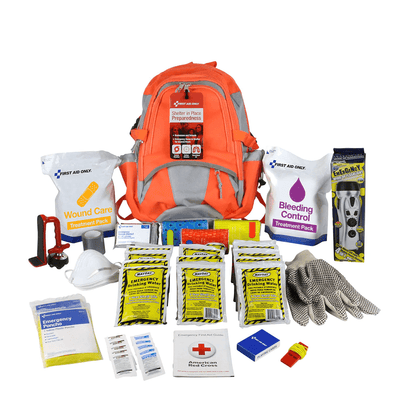
- Comfort and shelter: water, emergency blankets, a way to get news or communicate (crank radio), light, sanitation, and something to reinforce the door.
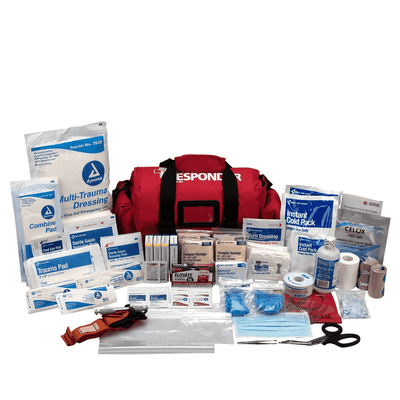
- Trauma and wound care: a tourniquet, hemostatic gauze, trauma dressings and pads, gloves, a CPR face shield, burn care, and enough organization to find any of it in seconds, not minutes.
That's the actual gap between a "toilet kit" and a real shelter-in-place kit: not the bucket itself, but everything that isn't in it.

The typical classroom lockdown bucket vs. a real Shelter-in-Place Preparedness kit: same room, very different level of readiness.
See our full emergency preparedness kits for more shelter and readiness supplies beyond the classroom or office.