Community Emergency Response Team (CERT) volunteers are often the first organized help on the scene after a disaster. This happens before professional responders can reach every household. But that only works if a team actually has the right gear on hand. This guide covers what belongs in a real CERT emergency kit. It covers what FEMA's CERT program actually requires, versus what's just a smart addition, and how to build or customize a kit for your specific team.
Quick Answer: What Belongs in a CERT Kit
- Medical and first aid: bandages, gauze, gloves, trauma shears, and a CPR mask.
- Search and rescue tools: flashlights, multi-tools, a hammer and nails, and rope.
- Fire safety: a fire extinguisher and fire-resistant gloves.
- Personal protective equipment: a hard hat, reflective vest, goggles, and a dust mask.
Full breakdown by category, and what "FEMA-compliant" actually means, is below.
Why CERT Emergency Kits Matter
CERT programs exist because professional responders can't be everywhere at once in a large-scale disaster. FEMA describes CERT as training that "educates volunteers about disaster preparedness for the hazards that may occur where they live and trains them in basic disaster response skills, such as fire safety, light search and rescue, and disaster medical operations." A trained team without the right equipment can still only do so much. A properly stocked kit is what turns that training into a real capability when an actual event happens.
That gap matters most in the exact window professional responders can't fill. In a widespread disaster, such as an earthquake, a major storm, or a regional flood, 911 and fire/EMS resources get overwhelmed fast. CERT teams are trained to triage, stabilize, and support their own neighborhoods until outside help arrives. A kit missing basic medical or rescue tools leaves a trained volunteer with the knowledge but not the means to act.
Outfitting a CERT Team? Let's Build Your Kit.
Request a CERT Kit QuoteCERT Emergency Kit Essentials
A real CERT kit is built around the same skill areas FEMA's CERT Basic Training covers: disaster medical operations, light search and rescue, and fire safety. Here's what belongs in each category.
Medical & First Aid Supplies
- Roller and triangle bandages, for wound care and improvised splinting. Both are taught in CERT medical training.
- Gauze dressings and adhesive bandages, for cuts, scrapes, and larger wounds.
- Nitrile gloves and hand sanitizer, for infection control when treating multiple patients.
- Trauma shears, for quickly cutting away clothing or debris from an injury.
- CPR mask, a protective barrier for resuscitation.
Search & Rescue Tools
- Flashlights and headlamps: CERT operations often happen with the power out.
- Multi-tools and pry bars, for freeing trapped people or clearing light debris.
- Hammer, nails, and plywood, for boarding up broken windows or unstable openings. This is a specific item on FEMA's own CERT equipment guidance.
- Rope or webbing, for securing areas or helping with light extraction.
Fire Safety Equipment
- Fire extinguisher, for small, containable fires only. CERT training is clear that teams don't fight structure fires.
- Fire-resistant gloves, for handling hot debris safely.
Personal Protective Equipment (PPE)
- Hard hat, for protection from falling debris in a damaged structure.
- Reflective vest, for visibility in low light or chaotic scenes.
- Safety goggles and an N95 or dust mask, for protection from debris and dust in the air.
"CERT is about readiness, people helping people, assisting emergency management, and doing the greatest good for the greatest number."
A description echoed across local CERT program mission statements nationwide, built on FEMA's national CERT curriculum
What "FEMA-Compliant" Actually Means for a CERT Kit
It's worth being precise here, since the phrase gets used loosely. FEMA doesn't certify or approve specific commercial CERT kits the way a standards body like ANSI certifies first aid kits. What FEMA does maintain is an Authorized Equipment List (AEL). This is a tool for emergency managers and CERT program coordinators. It defines which equipment types, not specific products, are eligible for FEMA preparedness grant funding. That includes CERT-specific items like vests, triage tarps, barrier tape, and water purification tablets.
So a genuinely well-built CERT kit is one that's aligned with FEMA's CERT Basic Training curriculum and equipment guidance. It covers the medical, search-and-rescue, fire safety, and PPE categories the training actually teaches. It doesn't just carry a formal "FEMA certification" that doesn't exist for commercial products. That's the standard we build our CERT kits against: real coverage of what CERT training prepares volunteers to do, not a marketing claim.
Sizing a CERT Kit for Your Team
CERT kits generally fall into three tiers, and picking the right one depends on team role more than budget alone.
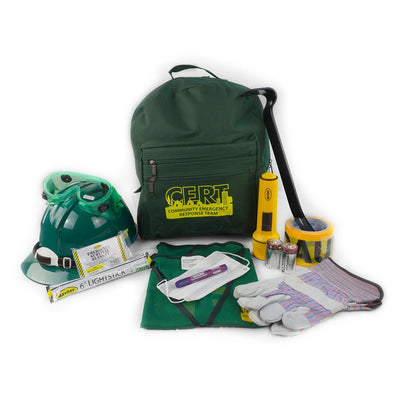
Individual/starter kits are built for a single trained volunteer to carry. They're lighter and backpack-sized, covering the core medical and PPE basics, so any team member has a baseline capability without waiting on a shared cache.
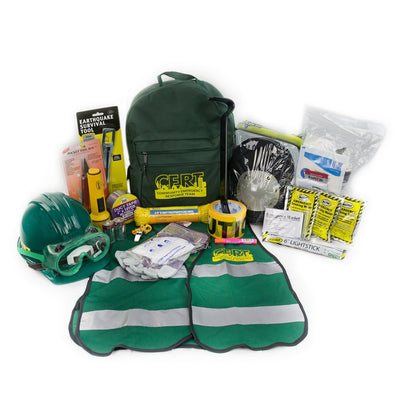
Team response backpacks step up the medical and search-and-rescue supply amounts for a small squad working together on a block or building. They're usually the right default for most active CERT teams.
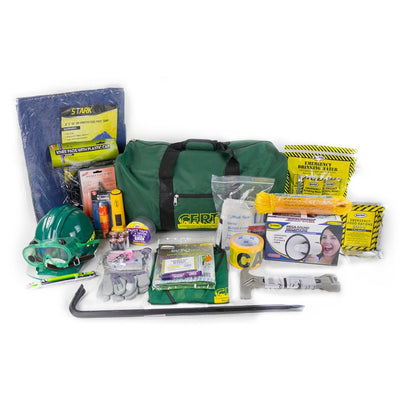
Deluxe/full deployment kits add the heavier gear: larger tool sets, expanded medical supplies, and more PPE. They're sized for a program's central cache or a larger team covering more ground. Programs with the budget often mix tiers, with a deluxe kit at a central staging point plus individual starter kits handed out to trained members.
Where to Get CERT Emergency Kits
Safety Kits Plus carries CERT kits sized for individual responders up through full team deployments, along with standalone gear to round out an existing kit. Here are a few of our most popular options for teams getting outfitted:
Browse our full CERT Gear & Supplies collection, or see our Ultimate Survival Kit Guide for broader disaster-readiness supplies beyond team-specific gear.