New York employers are facing a real, dated change to workplace first aid requirements. In December 2025, Governor Kathy Hochul signed Senate Bill S5922-A into law, adding a new Section 27-f to the New York Labor Law. A follow-up chapter amendment, Assembly Bill A9453, clarified the requirement and reset the compliance clock: Governor Hochul signed that amendment on February 13, 2026, and it pushed the law's effective date to December 13, 2026.
Here's the short version: any private employer in New York that's already required by OSHA to keep first aid supplies on hand must now also keep an opioid antagonist, most commonly naloxone, sold under the brand name Narcan, available in the workplace. The antagonist doesn't have to go in every individual first aid kit, but it does have to be on site and genuinely accessible.
This guide walks through what the law actually says, how to tell if your business is covered, where and how to deploy an antagonist, and a practical step-by-step plan to be ready well before the December 2026 deadline.
Quick Answer: Are We Covered, and What Do We Need?
- The law: New York's Section 27-f requires employers already covered by OSHA's first aid rule to also stock an opioid antagonist, usually naloxone.
- Effective date: December 13, 2026.
- Are you covered: if OSHA already expects you to keep first aid supplies on hand, plan to be covered.
- Where it goes: it doesn't need to be in every kit, just genuinely accessible somewhere in the workplace.
Full compliance details and a step-by-step plan are below.
Why New York Passed This Law
S5922-A wasn't written in a vacuum. The bill's own sponsor memo, filed by Senator Nathalia Fernandez, cites the state's own numbers:
- Opioid overdose deaths in New York increased more than 360% between 2010 and 2021, from 1,074 deaths to 5,017, according to the New York State Department of Health's 2023 Opioid Annual Report.
- That increase accelerated sharply after 2019: a 70.7% jump from 2,939 deaths that year to the 2021 total.
- Nationally, the U.S. Bureau of Labor Statistics recorded 525 workplace deaths from unintentional overdoses in 2022, the tenth consecutive annual increase, and a 619% rise since 2011.
- A National Safety Council workplace survey found more than 70% of employers reported opioids had a direct, negative effect on their workplace.
New York wasn't first to act on this, either. In September 2024, California passed AB 1976, directing Cal/OSHA to draft a regulation requiring naloxone nasal spray in workplace first aid kits, a law New York's own sponsor memo cites as precedent. The pattern is the same one that's been playing out with bleeding-control and AED mandates for years: a state watches a real, measurable risk climb, then folds a response into the first aid rules employers already have to follow.
New York opioid overdose deaths rose more than 360% between 2010 and 2021, from 1,074 to 5,017, the exact trend lawmakers cited when they passed the state's new workplace antagonist mandate.
Source: New York State Department of Health, 2023 Opioid Annual Report
What Labor Law §27-f Actually Requires
The statute itself is short. It amends the Labor Law to add Section 27-f, which requires that all employers federally mandated to have first aid supplies readily available must also include an opioid antagonist as part of those supplies.
The February 2026 chapter amendment (A9453) tightened up three things that the original bill left vague:
- Covered "employer" is defined broadly: any person, corporation, LLC, or association employing anyone in any occupation, industry, trade, business, or service. Government agencies, political subdivisions, and public authorities are specifically excluded.
- "Opioid antagonist" now expressly incorporates the definition already used in New York Public Health Law §3309: an FDA-approved drug that negates or neutralizes the pharmacological effects of an opioid, limited to naloxone and other medications the Department of Health approves for that purpose.
- Placement flexibility was clarified: the antagonist must be available in the workplace, but it does not have to be placed inside every individual first aid kit.
The amendment also directs the New York State Department of Labor, working with the Department of Health, to issue regulations before the December 13, 2026 effective date covering how many antagonists a given workplace needs based on its size, what training (if any) is required, and any other implementation details. Those regulations hadn't been published as of this writing; employers should plan around the core requirement now and expect the finer print (quantities, training specifics) to follow.
Am I a Covered Employer? A Practical Self-Check
This is the part most first-pass summaries of the law skip, and it's the part that actually determines whether S5922-A applies to your business. The law's trigger isn't a headcount or an industry code: it's whether OSHA's existing first aid standard already applies to you.
Under 29 CFR §1910.151(b), employers must keep adequate first aid supplies on hand whenever there's no infirmary, clinic, or hospital "in near proximity" to the workplace. OSHA has interpreted "near proximity" using a sliding scale based on how quickly professional care needs to arrive:
- 3–4 minutes: the standard for higher-hazard workplaces where serious injuries (falls, electrocution, amputation, uncontrolled bleeding) are a real possibility: manufacturing, warehousing, construction, industrial sites.
- Up to 15 minutes: the more lenient standard OSHA allows for lower-hazard settings like typical offices, where serious injury is less likely.
In practice: if emergency medical services genuinely can't reach your workplace inside that window, OSHA already expects you to have first aid supplies on hand, and as of December 2026, New York expects an opioid antagonist among them. Most manufacturing facilities, warehouses, distribution centers, construction sites, and multi-floor or campus-style offices will be covered. Businesses genuinely close to a hospital or urgent care may not be, though "close" is judged by response time, not straight-line distance.
If your safety documentation already references OSHA first aid obligations, or if you're already stocking first aid kits because your insurer or safety consultant told you to, you should plan to be covered under S5922-A.
Not Sure Where You Stand?
Our team can help you figure out whether your workplace is covered, and put together the right antagonist kit and placement plan if it is.
Get Compliance HelpSix Practical Steps to Get Compliant
1. Confirm whether you're covered. Walk through the OSHA "near proximity" self-check above for each facility, floor, or job site. If you're already maintaining first aid kits because of OSHA, assume S5922-A applies.
2. Decide which antagonist format and how many doses. Nasal spray naloxone is the practical default for non-medical staff. New York's Department of Labor may set minimum quantities by workplace size once its regulations are published. Plan for at least one two-dose package per identified deployment location as a starting point.
3. Review your legal protections with counsel. Make sure your written policy reflects the good-faith protections under Public Health Law §3309(4)(b) and the 911 Good Samaritan Law, so employees understand they're protected for acting reasonably.
4. Update your emergency procedures. Document when to call 911 (immediately, in essentially every case), who's encouraged to administer the antagonist, and how to report and log an incident afterward.
5. Train key employees. A short, focused session covering how to recognize overdose symptoms, where the antagonist is kept, and how to use it is usually enough. Build it into new-hire safety orientation going forward.
6. Monitor state guidance and maintain the program. Track expiration dates, refresh training as staff turns over, and watch for the Department of Labor's forthcoming regulations on quantities and training requirements.
A Simple Compliance Timeline
With the effective date now set at December 13, 2026, here's a realistic runway:
Now: assess and map. Confirm which locations are covered under OSHA's first aid standard. Note where first aid kits, AEDs, and safety stations already sit.
Next: choose placement and packaging. Pick locations for maximum accessibility, and choose portable vs. wall-mounted cases to match each location.
Then: install, label, and document. Place kits, add clear signage, and update written emergency procedures to reflect where antagonists are kept and who's authorized to use them.
Then: train and communicate. Run a short training session for managers and key staff; fold overdose response into new-hire orientation going forward.
Ongoing: monitor and maintain. Track expiration dates, review placement annually or after layout changes, and adjust once the Department of Labor publishes its regulations.
Waiting until late 2026 to start isn't a real risk if you begin now: the individual steps are quick. The risk is treating this like a check-the-box purchase instead of building it into your actual emergency response plan, which is the difference regulators (and more importantly, your own staff in a real emergency) will notice.
Legal Protections for Employers and Employees
New York backs this mandate with real liability protection for people who act in good faith to help someone overdosing:
- New York Public Health Law §3309(4)(b) states that use of an opioid antagonist under that section counts as first aid or emergency treatment for liability purposes, and that a person or entity acting reasonably and in good faith is not subject to criminal, civil, or administrative liability solely because of that action. The statute's protected-entity list explicitly includes workplaces alongside schools, retail stores, and other public-facing businesses.
- New York's 911 Good Samaritan Law provides separate protection against certain criminal liability for anyone who calls for emergency help during a drug or alcohol overdose.
Together, these mean an employee who follows your written procedure, administers naloxone in good faith, and calls 911 is protected, not exposed, for acting. That protection is worth stating plainly in your own policy, since fear of liability is one of the most common reasons employees hesitate to act in a real emergency.
Where to Keep Opioid Antagonists in Your Workplace
Because the law doesn't require an antagonist in every kit, you have real flexibility in where it lives, and that flexibility is worth using deliberately rather than defaulting to "wherever there's room." Good placement is visible, unlocked, and reachable in well under a minute from any point in the facility. Common choices include:
- Central first aid or safety stations
- Next to an AED
- Security desks or reception areas
- Construction trailers or field offices
- Break rooms or other high-traffic staff areas
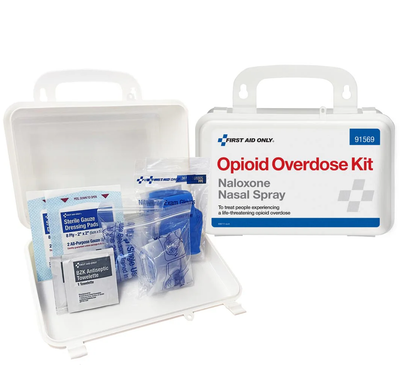
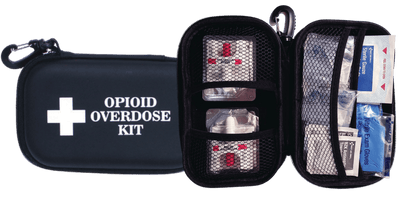
Whichever spot you pick, keep the antagonist in its own dedicated case rather than buried inside a general first aid kit: a case with a clear front or a breakaway/seal tab makes it obvious at a glance whether a dose has been used and needs replacing. A portable hardshell case suits supervisors and field staff who move between locations; a wall-mountable case with a clear front works better for a fixed, central spot like a break room or main safety station.
Choosing the Right Opioid Antagonist Format
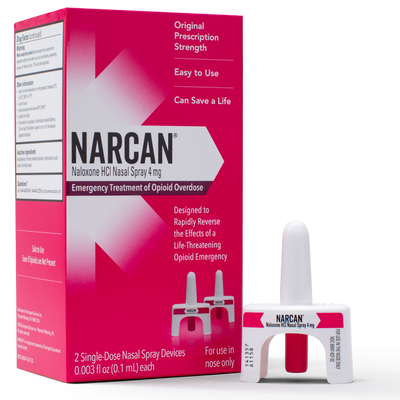
The statute doesn't mandate a specific brand or delivery method, but the practical choice is usually straightforward. Nasal spray naloxone (like Narcan) requires no needles, has simple step-by-step instructions, and is what most public overdose-response programs already train on: it's built for a non-medical bystander to use under pressure. Injectable naloxone exists too, but it generally requires more comfort with giving injections and is less practical unless you have medical staff on site. For the overwhelming majority of workplaces, nasal spray is the more defensible, easier-to-train-on choice.
Pair your antagonist kit with a fully stocked, OSHA-compliant first aid kit to cover the rest of your workplace first aid requirements in one place.