Building a car emergency kit from scratch takes real time. You have to source jumper cables, a first aid kit, a flashlight, and a dozen other items on your own, then find a bag that fits it all. If you'd rather skip that and buy a kit that's already assembled, the challenge shifts: a lot of "emergency kit" listings online are built to hit a low price, not to hold up in a real roadside situation. A Mylar blanket and a plastic-handled screwdriver look fine in a product photo. They're not what you want in your hands during a winter breakdown on a dark highway.
This guide compares ready-made car emergency kits worth buying in 2026; it covers what separates real gear from a gimmick kit, our picks by use case, and how to get a kit customized to your needs or branded with your company's logo if you're outfitting more than one vehicle. Prefer to build your own from scratch? See our full 25-item car emergency kit checklist instead.
Quick Answer: Best Car Emergency Kits by Category
- Best overall: AAA Excursion Roadside Emergency Kit, $71.33.
- Best for winter driving: AAA Winter Roadside Emergency Kit, $47.79.
- Best budget pick: AAA Essential Roadside Emergency Kit, $29.60.
- Best for road trips and families: AAA Destination Roadside Emergency Kit, $64.76.
- Best heavy-duty and fleet pick: Deluxe Vehicle Emergency Kit, $165.95.
Full comparisons and what's inside each kit are below.
What to Look For in a Car Emergency Kit
Not all "emergency kits" are built the same, and the differences aren't always obvious from a product photo or a big piece count on the box. A few things actually separate a kit worth keeping in your trunk from one that just looks the part:
- Jumper cable gauge. Lower gauge means thicker wire, and thicker wire carries more current without overheating or failing when you need it most. Look for 8-gauge or lower; cables rated 16 to 20-gauge, the kind bundled into bargain kits, often can't reliably start a car.
- Real first aid contents, not just bandages. A useful first aid section includes gauze, antiseptic, tape, and a sting relief pad; it's not just a handful of adhesive strips padded out to inflate the item count.
- Tool quality. Metal tools you'd actually use versus flimsy plastic-handled ones that bend under real pressure. You're not building a permanent toolbox, but the tools still need to work once.
- Storage and organization. A durable case or bag that fits your vehicle: under the seat for compact kits, mounted in the trunk for larger ones; it should have enough structure that contents don't end up loose after a few trips.
- Piece counts are a marketing number, not a quality signal. Kit makers often count each cable tie or bandage as a separate "piece" to advertise a bigger number. A 42-piece kit with the right core items can be more useful than a 150-piece kit padded with duplicates.
32 million roadside assistance calls were logged by AAA alone in 2025.
Breakdowns are more common than most drivers assume; a good kit turns a bad night into a manageable one.
Best Car Emergency Kits to Buy in 2026
Rather than a single ranked list, here are our picks by what you're actually using the kit for. These are kits we carry and stand behind, not a rotating cast of marketplace listings we've never opened.
Best Overall: AAA Excursion Roadside Emergency Kit
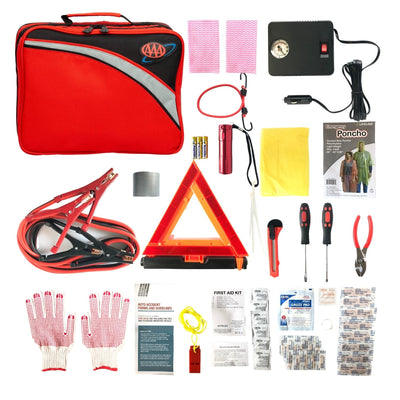
At $71.33, the 76-piece AAA Excursion is the kit we'd point most drivers to first. It covers the fundamentals well instead of padding the count: 10-foot, 8-gauge jumper cables (thick enough to actually work), an air compressor with gauge, a 9-LED flashlight, pliers, screwdrivers, a utility knife, and a first aid section with real wound-care basics rather than just bandages. This AAA-branded line has also picked up independent recognition elsewhere; it's the same kit family that's shown up as an editor's pick in other roadside-kit roundups, for whatever that outside vote of confidence is worth alongside our own.
Best for Winter Driving: AAA Winter Roadside Emergency Kit
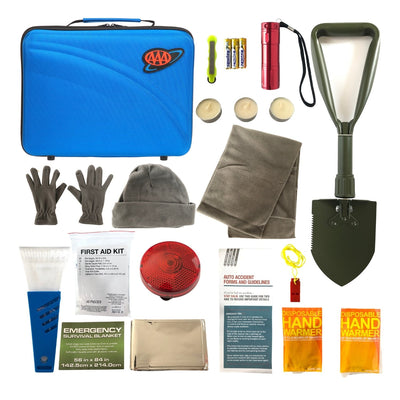
At $47.79, this kit swaps general-purpose tools for cold-specific ones: a folding shovel, an ice scraper, a 3-piece fleece set (cap, gloves, scarf), two hand warmers, a survival blanket, emergency candles, and a fire starter, alongside the same first aid basics found across the AAA line. If you're outfitting a vehicle that regularly deals with snow and ice, this is the pick built for that, not a general kit with a blanket thrown in.
Best Budget Pick: AAA Essential Roadside Emergency Kit
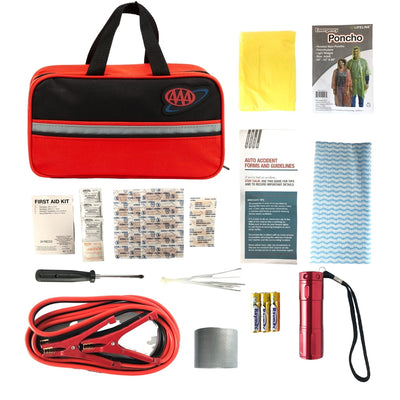
At $29.60, the 42-piece Essential kit covers the core basics: booster cables, a 9-LED flashlight, a 2-in-1 screwdriver, and first aid essentials; it skips the extras that drive up price on the larger kits. It's a reasonable floor to start from, especially for a second vehicle or a teen driver's first car, though we'd treat it as a base to build on rather than a complete solution for long trips or remote driving.
Best for Road Trips & Families: AAA Destination Roadside Emergency Kit
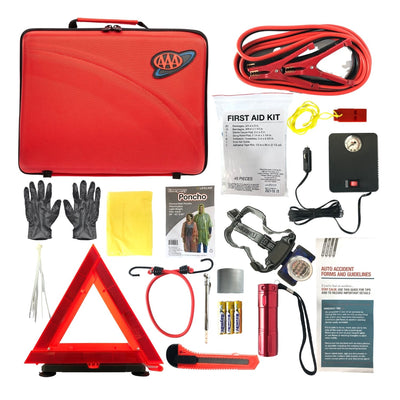
At $64.76, the Destination kit adds things the Essential and Excursion kits don't: a tire pressure gauge, an air inflator, a 10-LED headlamp (hands-free, useful for anyone actually working on the car), and an emergency poncho, on top of the standard 8-gauge jumper cables and first aid basics. It's the kit we'd suggest for a family vehicle that's regularly on longer drives.
Best Heavy-Duty & Fleet Pick: Deluxe Vehicle Emergency Kit
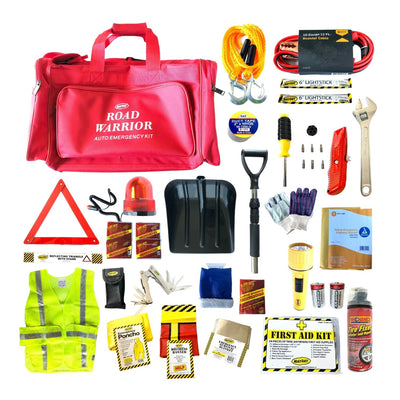
At $165.95, this is the most complete kit in our lineup, and the one we point fleet managers and HR teams toward. It includes a 3-piece folding snow shovel, heavy-duty 6-gauge jumper cables, a 12V magnetic work light, a tow rope rated to 6,500 lbs, a 54-piece first aid kit, a high-visibility safety vest, a waterproof distress banner, and cold-weather gear (ice scraper, hand warmers, body warmer, solar blanket); it's genuinely built for someone who can't afford to be under-equipped, whether that's a personal vehicle used for long-distance driving or a company fleet. It's also part of our Heavy Duty Roadside line, which you can customize from our stock contents or brand with your company's logo; more on that below.