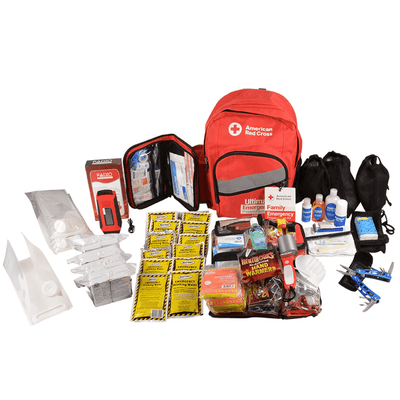
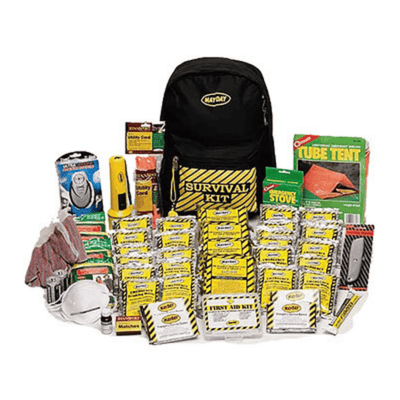
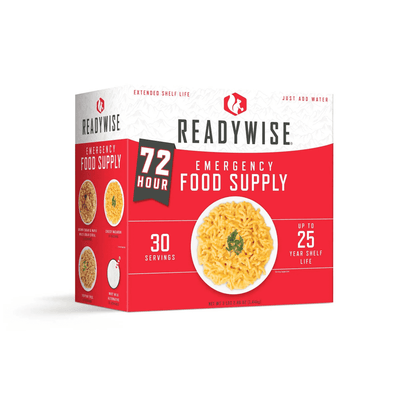
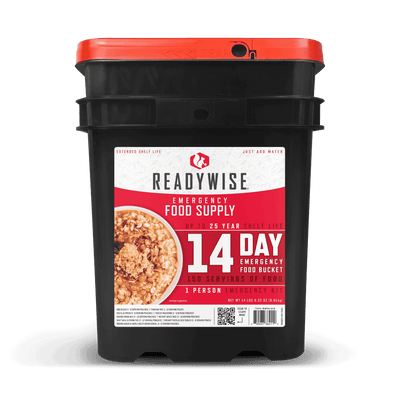
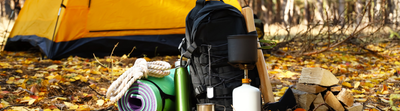
If a disaster knocked out power, water, or road access to your neighborhood tonight, could your household get through the next three days without a store run? That's the exact question a 72-hour emergency kit is built to answer. FEMA, the American Red Cross, and the CDC all use 72 hours as the baseline planning window. That's roughly how long it can take emergency services to reach every affected household after a major event, restore utilities, or reopen roads. A well-built kit isn't about doomsday prepping. It's about making sure your family can eat, drink, stay warm, and handle minor injuries while you wait it out, whether you're sheltering at home or riding out a shelter-in-place order.
This guide walks through exactly what belongs in a family 72-hour kit. It covers how much water and food to store per person, what's easy to forget, like documents, medications, and pet supplies, and how to size a kit to your household instead of guessing.
Quick Answer: What to Pack in a Family 72-Hour Kit
- Water and food: one gallon of water per person per day, and about 2,000 calories of non-perishable food per adult per day, for at least 3 days.
- First aid and medical: a stocked first aid kit and a 7-day supply of prescription medications.
- Tools and communication: a flashlight, a weather radio, a whistle, and a charged power bank.
- Shelter and sanitation: emergency blankets, a change of clothing, and basic hygiene supplies.
- Documents, cash, and power: copies of key documents, small bills, and a backup charger.
- Special needs: extra supplies for infants, elderly family members, and pets.
Full breakdown by category is below.
Why Your Family Needs a 72-Hour Kit
Most households own some of what they'd need in an emergency: a flashlight in a drawer, a half-used first aid kit, some bottled water in the garage. The problem is rarely that the supplies don't exist somewhere in the house. It's that they're scattered, some are expired or dead, and nobody could grab everything in five minutes during a real event. A 72-hour kit solves that by putting everything in one place, checked and current. Preparation isn't something you do in the moment. It's already done.
It also matters more than it used to. Utility outages, boil-water notices, and regional supply disruptions aren't rare, isolated events anymore. Winter storms, severe weather, and wildfires now account for most federal disaster declarations in a given year. None of those need a full evacuation to disrupt daily life for several days. A 72-hour kit is the right tool for that far more common scenario, not just the rare worst-case one.
Bug-Out Bag vs. 72-Hour Home Kit: What's the Difference?
These two get used interchangeably online, but they're built for different situations, and most families genuinely need both.
- A bug-out bag is a single-person, grab-and-go bag built around one priority: getting out fast. It's lighter, more compact, and assumes you're moving on foot if you have to. See our Bug Out Bag Checklist for a full item-by-item breakdown.
- A 72-hour home kit (this guide) is built to support your whole household in place: sheltering at home, in a shelter-in-place order, or in your car if you can't get far. It's heavier, holds more food and water per person, and doesn't assume you're carrying it on your back for miles.
If you only build one, a home kit covers more of the situations an average family actually faces. If you want full coverage, build both: a home kit that stays put, and a lighter bug-out bag by the door in case you do need to leave on short notice.
How Much Water and Food to Store
This is the part people most often underestimate, because the numbers scale with your household size, not a fixed box of supplies.
FEMA, the Red Cross, and the CDC all recommend the same baseline: at least 1 gallon of water per person, per day, for a minimum of 3 days. A 2-week supply is the better long-term target, where storage space allows. That's roughly half for drinking and half for food prep and basic hygiene. Increase this amount if anyone in your household is pregnant or sick, or if you live somewhere hot.
For a family of four, that's a minimum of 12 gallons for 72 hours. That's more than most households have sitting around, already sorted and ready. Commercially bottled, sealed water is the safest and easiest option to store long-term. If you fill your own containers, rotate them roughly every 6 months.
Food is measured in calories, not cans. Plan for roughly 2,000 calories per adult per day, 1,400–1,600 for a child, and 3,000 or more for anyone doing heavy physical activity during the event. Stick to non-perishable food that needs little or no water, cooking, or refrigeration. Freeze-dried meal pouches, shelf-stable proteins, and ready-to-eat items are the standard picks. Add a manual can opener if anything in your kit needs one.
Beyond Food & Water: The Rest of Your Kit
First Aid & Medical
- A stocked first aid kit sized for your household (see our Essential First Aid Kit Checklist if you're building one from scratch).
- At least a 7-day supply of any prescription medications, with dosage instructions.
- Glasses, hearing aid batteries, or other medical devices household members rely on daily.
- A basic reference card with each family member's allergies and medical conditions.
Tools, Light & Communication
- Flashlight and extra batteries (avoid candles indoors, since they're a fire risk during an already-stressful situation).
- Battery-powered or hand-crank NOAA weather radio.
- Whistle, to signal for help without shouting.
- Multi-tool or basic wrench/pliers set (to shut off utilities if instructed).
- Cell phone with a portable charger or power bank, kept charged.
Shelter, Warmth & Sanitation
- Emergency blankets or sleeping bags, one per person.
- A complete change of clothing and sturdy shoes per person.
- Plastic sheeting and duct tape (for sealing a room during a shelter-in-place order).
- Moist towelettes, garbage bags, and plastic ties for basic sanitation.
- Any household-specific hygiene items (feminine supplies, contact solution, etc.).
Documents, Cash & Power
- Copies of ID, insurance policies, and bank account records (physical or on a password-protected drive).
- Small amount of cash in small bills. Card readers and ATMs don't work without power.
- A local paper map, in case cell networks or GPS are down.
- Backup power bank or car charger.
Special Needs: Infants, Elderly Family Members & Pets
This is the section most generic checklists skip, and it's usually the one that actually determines whether a family's kit works in practice.
- Infants: Formula, diapers, wipes, and any bottles or feeding supplies for at least 3 days. Size up if you're building toward a 2-week supply.
- Elderly or mobility-limited family members: Extra mobility aids, hearing aid batteries, and any assistive devices they depend on daily. Don't assume you can improvise a substitute mid-emergency.
- Household members with ongoing medical conditions: A written list of medications, dosages, and conditions for each person, kept with the kit. This helps if someone else has to step in.
- Pets: Food, water, a leash or carrier, and copies of vaccination records. Many emergency shelters require proof of vaccination before they'll accept an animal.
None of this needs to be elaborate. A gallon zip bag with a week of a specific medication and a photocopy of the prescription label solves most of this category in five minutes.
Sizing Your Kit by Household
The single most common mistake is buying one kit sized for one person and calling it done for a family of four. Water and food scale directly with headcount. Most of your other gear, like the radio, tools, and documents folder, doesn't need to. Here's a practical way to think about it:
- 1–2 people: A single sized survival backpack covers water, food, and basic gear for a couple or a small household without much redundancy needed.
- Family of 4: Step up to a 4-person kit as your base, then add dedicated food and water separately if you want to extend past the 72-hour minimum toward a 2-week supply.
- Larger or multi-generational households: Consider two kits split across the home rather than one oversized kit. They're easier to grab, easier to check and rotate, and one damaged or inaccessible kit won't take out your entire supply.
Ready to Build Your Kit?
Shop family-sized survival backpacks and emergency food & water supplies to round yours out.
Shop Survival KitsWhat Should a Family Kit Cost?
Budgets vary by how much you're buying pre-assembled versus building yourself. But a reasonable range for a family of four covers a wide spread. A solid basic kit typically runs $100–$150. A premium version, with better food quality, a sturdier bag, and a bigger first aid component, can run $200–$300. Neither end is wrong. The cheaper end covers the FEMA minimum. The higher end buys better shelf life, comfort, and backup supply. Buying a base kit and adding dedicated food and water separately, rather than one all-in-one box, is often the more cost-efficient way to size up toward a 2-week supply without paying premium-kit prices for the whole thing.
Where to Store Your Kit
Pick a spot that's accessible without power, not a locked electronic safe. Keep it away from temperature extremes, not a hot attic or an unheated garage in freezing climates, since heat and cold can spoil food and medication faster. Make sure every adult in the household knows where it is. A kit no one can find in the dark isn't doing its job. If you use a vehicle regularly, keep a smaller secondary kit in the trunk for when you're away from home. See our Car Emergency Kit List for what that one should hold.
Common Mistakes to Avoid
- Buying a kit and never opening it again. Check expiration dates on food, water, and medications at least once a year. Tie it to a date you'll actually remember, like a clock change.
- Sizing for one person instead of your actual household. A kit built for one adult runs out fast when it's actually feeding a family of four.
- Skipping the special-needs items because they feel like a separate project. They're usually the fastest part to finish and the most disruptive to miss.
- Storing it somewhere only one person knows about. Every adult in the household should know exactly where it is.
- Treating 72 hours as a hard ceiling. It's a minimum, not a target. Extending toward a 2-week supply is worth it if you have the storage space.